
What is smart money on Polymarket, and where is it betting?
Every price on Polymarket is a crowd guess. Smart Money shows you what the traders with the best records are guessing instead.
Key Takeaways
- Smart money on Datadash means the 1,000 most profitable Polymarket wallets of all time, unless you pick a different group.
- For every open market, we turn where their dollars sit into odds and compare them with the live price. The gap is called Edge.
- A market ranks high only when the edge is wide, many wallets agree, and real money is at risk.
- Smart money can be wrong. Treat it as a strong second opinion to research, not a bet slip.
Contents
On October 1, 2026, the market gave Benjamin Netanyahu about a 33% chance of being Israel's next prime minister.1 The 1,000 most profitable wallets on Polymarket saw it very differently. Between them, they had about $813,000 riding against him and only about $46,000 on him. Weighted by those dollars, they gave him roughly a 5% chance.
That gap, between what the crowd is paying and what proven traders are betting, is what our Smart Money page is built to show you. Here's what smart money means, how we measure it, and how to use it without getting burned.
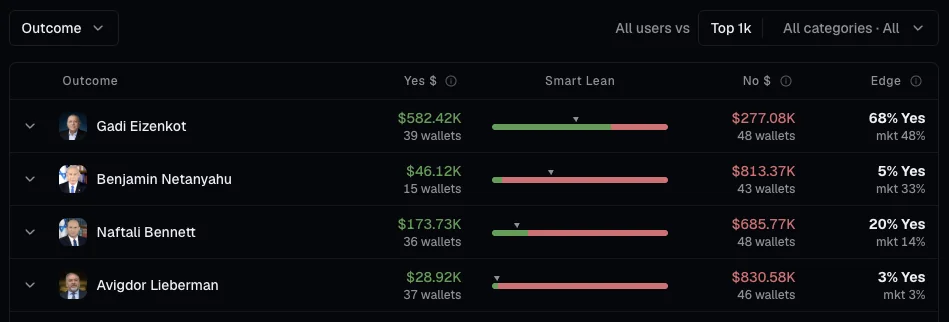
The Israel election's Smart Money tab on October 1, 2026. Netanyahu: 5% from smart money, 33% from the market.
What smart money means on Polymarket
"Smart money" is an old idea from finance and sports betting: some money is better informed than the rest, and it pays to know where it's going. The hard part has always been knowing whose money that is.
Polymarket makes that part easy. Every trade settles on-chain, so every wallet carries a public track record. You don't have to guess who has been good. You can look it up.
So on Datadash, smart money starts with a simple rule: the top 1,000 wallets on the all-time profit leaderboard. It's a rule, not a hand-picked list, so the group changes as traders win and lose. (If you're curious how we work out each wallet's profit, we wrote about how our PnL differs from Polymarket's.)
You can also decide for yourself who counts as smart. The scope picker at the top of the page lets you:
- change the cutoff, say the top 100 instead of the top 1,000
- require a minimum profit or ROI
- measure over the last 7 days, 30 days, year or all time
- judge traders only on the categories you pick, like Politics or Soccer
- or pick any saved cohort, including one you built yourself
How we turn wallets into odds
Take one market and add up the current value of what the smart money wallets hold on each side. Say it comes to $75,000 on Yes and $25,000 on No. Yes has 75% of their dollars, so the Smart Money Odds are 75%.
Now compare that with the price. On Polymarket, a price is a probability (Polymarket explains it here), so if Yes trades at 60¢ on that same market, the crowd is giving it about a 60% chance. Smart money says 75%, the crowd says 60%: smart money is 15 points more bullish, and that 15-point gap is what we call Edge.
Two details keep the number honest:
- We count each wallet's net bet. A wallet holding both Yes and No on the same market only counts for the side it's actually leaning toward, so market makers who sit on both sides don't muddy the picture.
- We understand multi-outcome events. In an election with ten candidates, a No on one candidate is really a bet on the other nine. As Polymarket's own docs put it, "betting against one outcome is economically equivalent to betting for all other outcomes" (source). We fold those bets together, so each candidate's odds reflect every wallet's real position across the whole event.
Dollars, not headcount
Back to Israel. For Gadi Eizenkot, more of the top 1,000 wallets were betting against him (48) than for him (39). Count heads and you'd conclude that smart money doesn't rate him. But the 39 wallets on Yes had put in about $582,000, against $277,000 on No. By dollars, smart money gave him 68%, while the market said 48%.
| Israel's next prime minister | Market Odds | Smart Money Odds | Smart money on Yes | Smart money on No |
|---|---|---|---|---|
| Benjamin Netanyahu | 33% | 5% | $46.12K (15) | $813.37K (43) |
| Gadi Eizenkot | 48% | 68% | $582.42K (39) | $277.08K (48) |
Top 1,000 wallets by all-time profit, as of October 1, 2026. Wallet counts in parentheses.
We show both the dollars and the wallet counts, because sometimes the story is one big conviction and sometimes it's a crowd of small ones. Both are worth knowing.
Reading the Smart Money page
The Smart Money page runs this comparison across every open market with meaningful liquidity and ranks them. Each row tells you:
- Side: which way smart money leans, with the market's price for that side and then smart money's, like "No 66.8¢ vs Top 1,000 94.6¢"
- Edge: how far apart those two prices are
- At Risk: how many dollars the smart money wallets hold on that side
- Wallets: how many of them are on that side
- Liquidity and Days Left: whether you can actually trade it, and how long you'd wait for an answer
Then there's Score, a 0 to 100 rank that is only high when the edge is wide, lots of wallets agree and plenty of money is behind it. In the app's own words: strong on all three, or it is not a signal. Scores are ranked within the view you're looking at, so compare them within one view, not across different groups of wallets.
Here's the top of the default view on October 1:
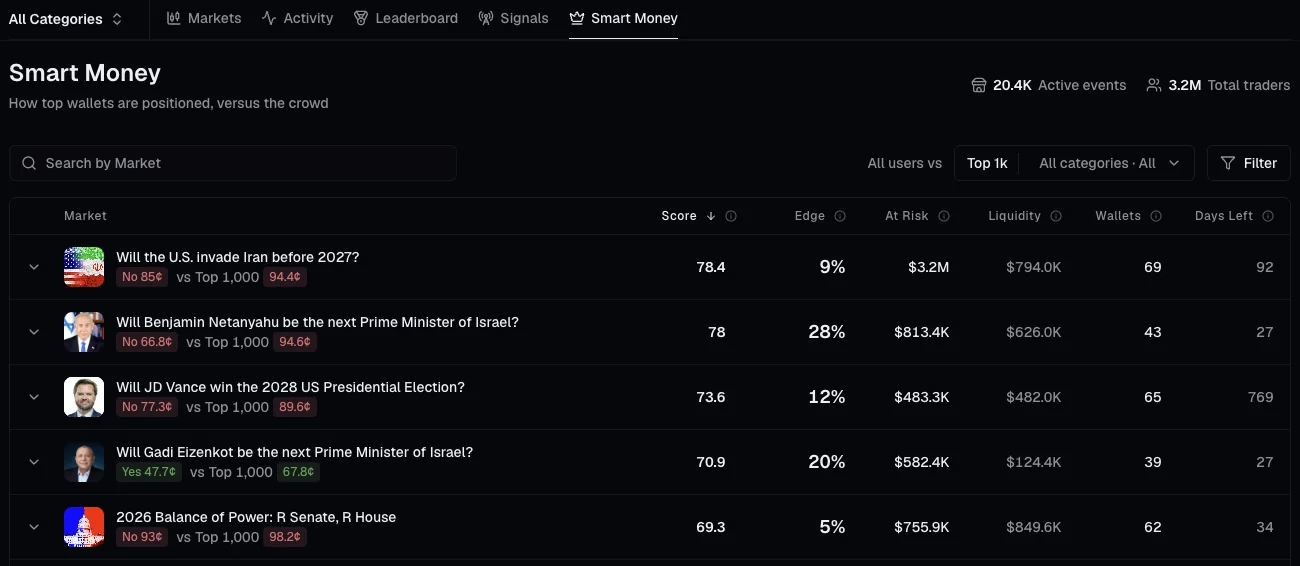
The Smart Money page on October 1, 2026. Netanyahu and Eizenkot are the second and fourth rows.
Open a market to see who's behind the number
Every market page has a Smart Money tab. It shows a Yes and No bar comparing Smart Money Odds with Market Odds, and below it, the actual wallets on each side, with their average entry price, how much they have at risk and their open profit or loss. Here's the Israel election.
This is where the real research happens. Click through to a few of those wallets. Are they politics traders, or sports bettors who wandered in? Did they buy last week or last year? And if smart money bought at 40¢ and the price is now 70¢, most of the easy money is already gone. That last question is exactly what our Signal score is designed to answer.
When smart money gets it wrong
It does, and you should expect it to. A few reasons why:
- Hedges. A position you can see may be one half of a bigger bet placed somewhere you can't see.
- Luck. One huge win can keep a wallet in the all-time top 1,000 for years. If that worries you, tighten the scope to a category, a recent window or a minimum ROI.
- Timing. Being early looks exactly like being wrong, right up until it doesn't. Big wallets can sit on a position for months.
- One person, many wallets. Some traders spread their money across several wallets. We see each wallet on its own.
So treat a big edge as a question, not an answer: why do these traders disagree with the crowd, and do you agree with them? Datadash shows public on-chain data and how other traders are positioned. It isn't financial advice, and every decision is yours.
Try it
- Open Smart Money and sort by Edge or At Risk.
- Switch the scope to a category you know, like the top 100 Politics traders, and watch how the list changes.
- Build your own group of traders as a cohort and point Smart Money at it.
- Want to know the moment they move? Set up an alert.
Building something of your own? The same data is available through our API and MCP server.
Footnotes
-
Market Odds on Datadash are normalized so that every candidate in a multi-outcome event adds up to 100%, which can make them differ slightly from the raw price on Polymarket. Netanyahu's Yes shares traded at 33¢ there at the time. ↩